Stained Glass Windows

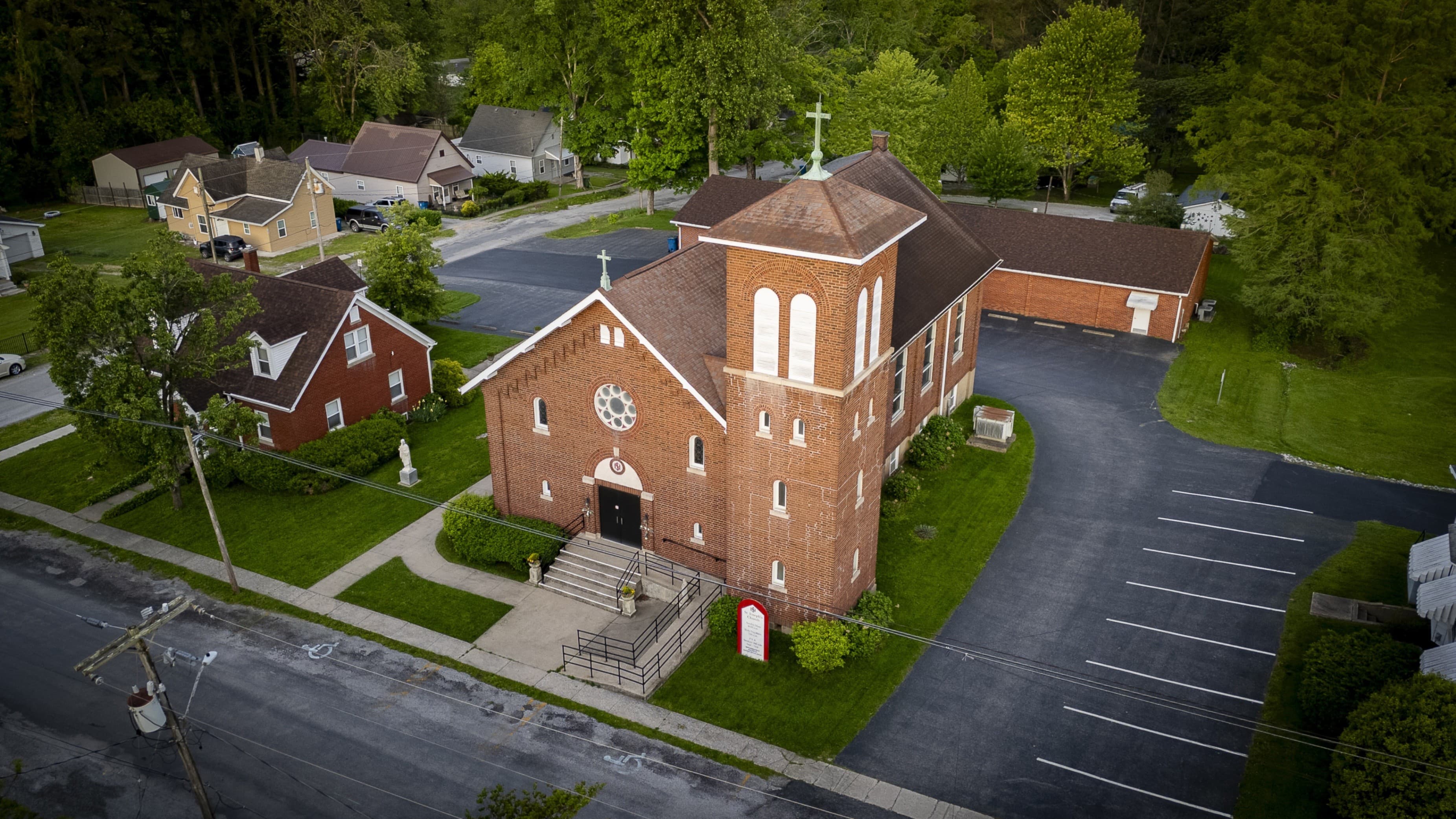
St. Joseph's Catholic Church · Cobden, Illinois

The ten major stained glass windows of St. Joseph's Church follow a logical progression of salvation history and describe a clear spiritual journey — from the Immaculate Conception of Mary, through the life and Passion of Christ, to the witness of the saints and the patronage of St. Joseph.

Congregatio Sancti Spiritus

Congregatio Sancti Spiritus

Window 1

The Immaculate Conception

(December 8)

Symbology
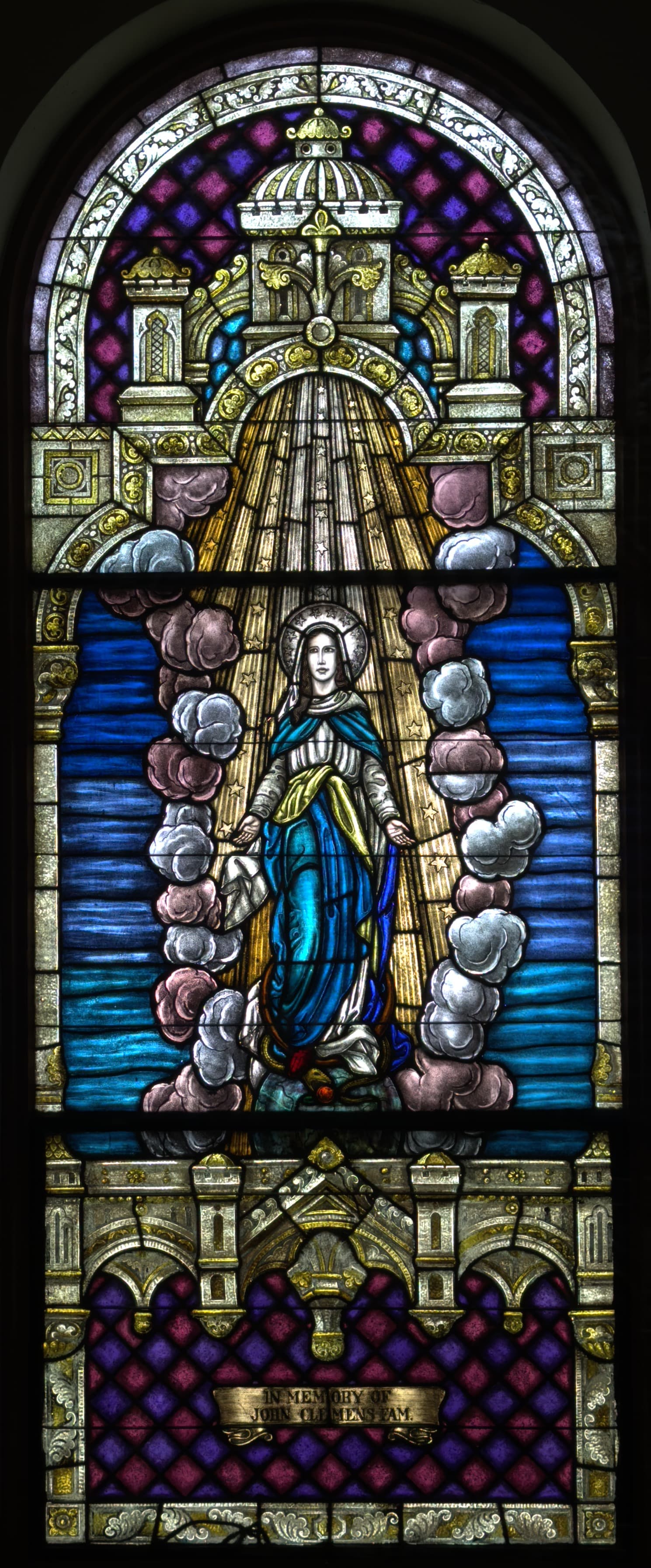
This image celebrates Mary's unique privilege — preserved from original sin so that she could be the perfect Mother of the second person of the Trinity. It is a triumphant, doctrinal image rather than a historic scene from her life. Mary stands triumphantly in the center, dressed in her traditional blue mantle over a white tunic. Blue signifies her heavenly dignity and purity; white represents her sinlessness. Her hands are open in a gesture of grace and welcome. The handkerchief falling from her right hand represents Mary's complete detachment from earthly things, and her total surrender to God's will. Fulfilling Revelation 12:1, she is "clothed with the sun", surrounded by a mandorla of light and stars, symbolizing divine light and glory. She is also standing on the crescent moon — "A woman clothed with the sun, with the moon under her feet" — showing Mary's exalted dignity and her dominion over creation. And finally, the stars around her head fulfill "on her head a crown of twelve stars" and emphasize her queenship and glory. Crushing the serpent that holds the apple in its mouth directly fulfills Genesis 3:15, "She will crush your head." It symbolizes Mary's complete victory over original sin. Her slipper is red, echoing the red robes worn by Jesus in the Sacred Heart and Agony in the Garden windows, linking Mary to Christ's redemptive sacrifice. The Immaculate Conception is the doctrinal foundation that made Mary worthy and capable of giving a sinless humanity to the Son of God. Because she was preserved from original sin, she could give her perfect "Yes" and become the Mother of God.

Story

Mary is preserved from original sin from the first moment of her existence. "The singular grace and privilege by which the Blessed Virgin Mary was preserved free from all stain of original sin from the first moment of her conception."

Window 2

St. Anne and Mary

(July 26)

Symbology
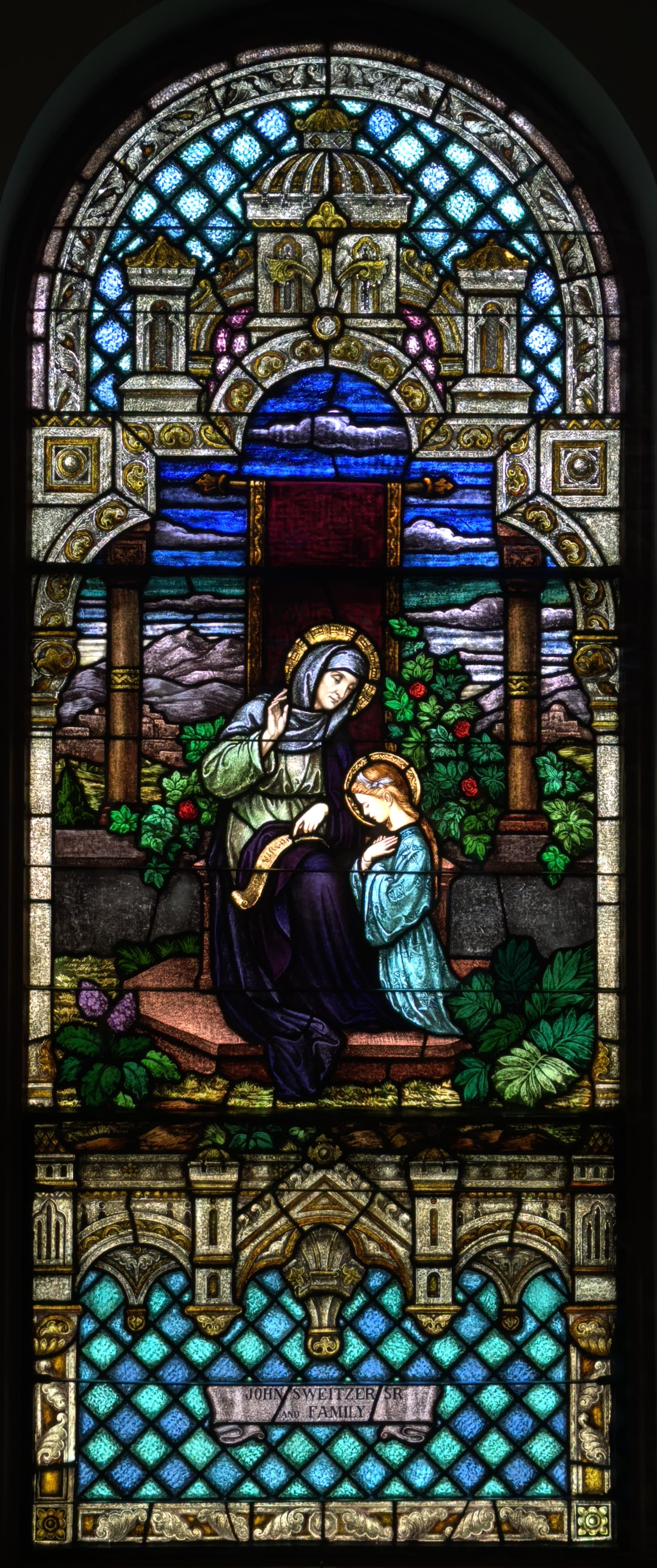
Anne and her husband Joachim were a devout but childless couple, who prayed to God for a child. Long after their childbearing years had passed, and distressed by the public reproach for their childlessness, Joachim withdrew into the desert for a time of prayer, fasting and penance. During this time, an angel appeared to each of them separately announcing that Anne would conceive a daughter who would be "renowned throughout the world." Anne did conceive a child, and when she was born they named her Mary. When Mary was three years old, Joachim and Anne fulfilled their vow by bringing her to the Temple in Jerusalem to be presented and dedicated to the service of God. This act of profound generosity and obedience is honored by the Church as a model of parental faith, sacrificial love and trust in divine providence. The young Mary is listening attentively with hands joined in prayer. The garden setting evokes the idea of a new Eden — a holy, grace-filled environment where Mary is formed in virtue and with God ever-present. The red roses symbolize the "Mystical Rose" title of Mary from the Litany of Loreto. They also connect to St. Thérèse, who saw herself as a "little rose" offering small acts of love to Jesus. This image portrays Anne faithfully instructing Mary in the Old Testament scriptures: the faithful transmission of God's promises across generations within the Holy Family. The phrase on the scroll is "Ecce Virgo Concipiet" ("Behold, a virgin shall conceive"): Isaiah 7:14, and her finger is pointing to the word "Virgo", emphasizing the prophecy of the Virgin Birth — a central text linking the Old Testament to the Incarnation of God in the earth and Mary's role as the "Mother of God".

Story

Faith is passed from one generation to the next. Mary was formed in holiness and knowledge of God's Word long before the Annunciation. God formed Mary in Anne's womb with the singular grace and privilege of being preserved free from all stain of original sin and St. Anne continues the formation with Scripture and piety.

Window 3

The Annunciation

(March 25)

Symbology
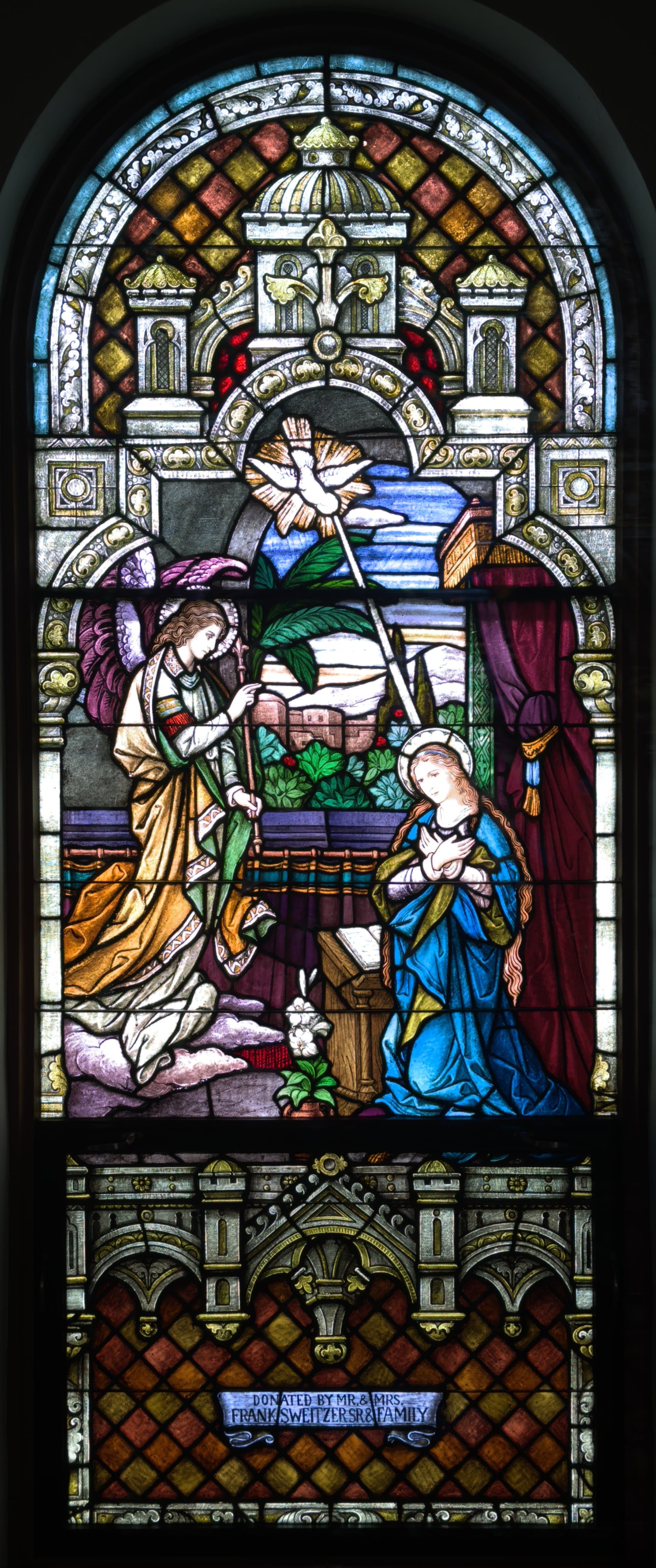
This image illustrates the moment when the Angel Gabriel announces to Mary that she will conceive the Son of God by the power of the Holy Spirit. Mary's response is her famous fiat: "Behold, I am the handmaid of the Lord; let it be done to me according to your word." — Luke 1:38 This is the moment God became man. It is the hinge moment of salvation history. Catholic teaching holds that at this moment: • Mary became Theotokos (Mother of God) • The Second Person of the Trinity took on human nature • Mary's "yes" made possible the redemption of humanity. The Angel Gabriel (on the left) kneels before Mary, holding a lily (symbol of purity) and a staff. His multicolored wings and ornate robe show his heavenly dignity. The Virgin Mary is shown in a posture of humble acceptance, with hands crossed over her chest. She is dressed in her traditional blue mantle. The Holy Spirit appears as a dove (just like at Jesus' baptism) descending from heaven in a burst of light, representing the moment of the Incarnation. The scene contains stone architecture, symbolizing a Temple space. The red curtain symbolizes the veil of the Temple, behind which lay the Ark of the Covenant, where God's presence dwelt. At the moment of the Annunciation, Mary herself becomes the new Holy of Holies — the living Ark of the Covenant — in whom God takes up residence through the Incarnation. The open book represents the Scriptures, which foretold this event, and prepares Mary to receive the Word made Flesh. "Therefore the Lord himself will give you a sign: Behold, a virgin shall conceive and bear a son, and shall call his name Immanuel." — Isaiah 7:14

Story

The Angel addresses her by Title, "Full of Grace" and announces that she will conceive the Son of God. This hearkens back to the grace given her at the Immaculate Conception. Her humble reply "Let it be done to me according to your word" makes the incarnation possible.

Window 4

The Holy Family

(Sunday between Christmas & New Year)

Symbology
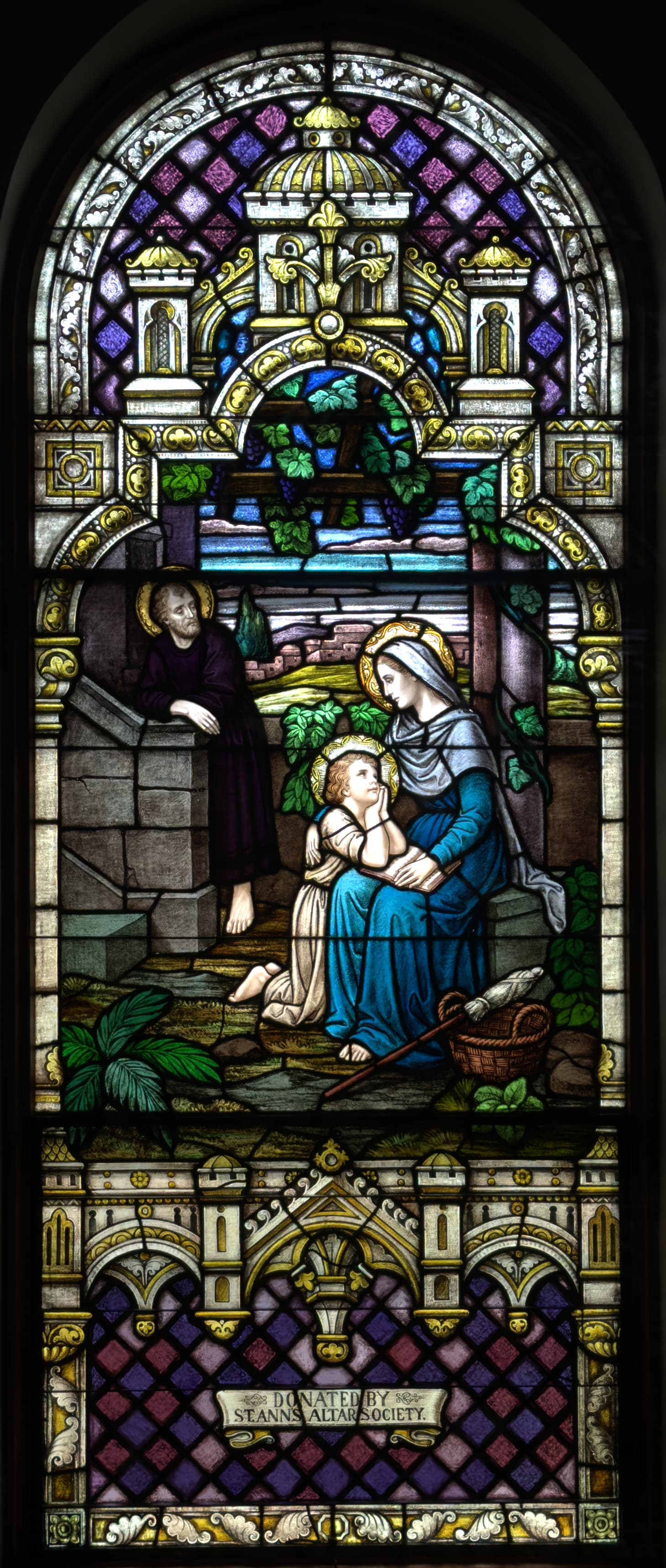
The Holy Family is the model for all Christian families. In this image, the Holy Family is in an outdoor garden courtyard, with Nazareth in the background, to set the scene as the daily life of the Holy Family. Mary is seated on a stone step, wearing her traditional blue mantle over a lighter tunic. She holds an open book (the Scriptures) in her lap while gently supporting the child Jesus, who kneels beside her with hands in prayer. Joseph stands watchfully in the background. A woven basket and a long handled broom rest at Mary's feet, representing domestic work and Joseph's trade as a carpenter, highlighting the simplicity and dignity of daily labor in the Holy Family's home. The cruciform halo on the Child Jesus is reserved for depictions of Christ and signifies His divinity. The circular aureoles (saintly halos) on Mary and Joseph indicate they are saints. The book on Mary's lap represents Mary as the "Seat of Wisdom" (a title from the Litany of Loreto). She is the first and perfect disciple, instructing the Incarnate Word Himself in the Sacred Scriptures. The Child Jesus praying represents the model of perfect obedience and prayer to the Father. It models the prayer life that every Christian is called to imitate. Joseph, observant in the background, is the "Righteous Man" (Matthew 1:19) and protector of the Holy Family. He is not passive — he is vigilant. His position in the background emphasizes his role as guardian and head of the household. This reflects his patronage as protector of the Church and model for fathers. Nazareth, in the background, represents the "hidden life" of Jesus: 30 years of obscurity before His public ministry. The Church teaches that these hidden years are profoundly redemptive.

Story

The hidden life in Nazareth. Jesus is formed in a holy, prayerful and hardworking family under Mary and Joseph. The model for all Christian families.

Window 5

The Good Shepherd

(4th Sunday of Easter)

Symbology
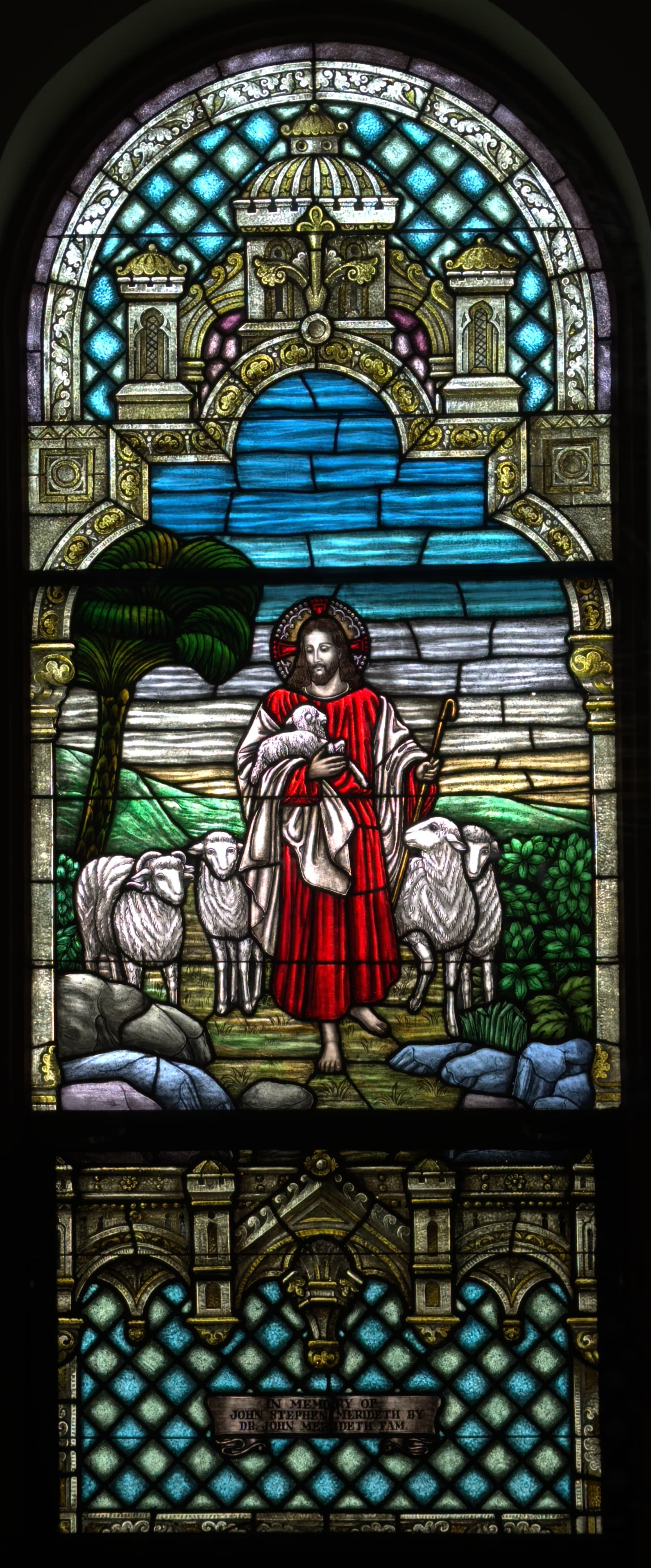
Jesus, the Good Shepherd, is standing in a pastoral landscape, wearing a red robe (Passion and Kingship). He has a cruciform halo (with a red cross) indicating His divinity. He is tenderly carrying a lamb in His arms while holding a shepherd's crook in His other hand. The background features green hills, trees, rocks and a stone wall, evoking the biblical setting of ancient Judea, and the idea of "green pastures" from Psalm 23 ("The Lord is my shepherd…"). "I am the good shepherd. The good shepherd lays down his life for the sheep. … I know my own and my own know me. … I have other sheep, that are not of this fold; I must bring them also. … And I lay down my life for the sheep." — John 10:11, 14, 16 The lamb in His arms represents the individual soul that has strayed and is rescued by the Shepherd. The crook symbolizes His authority, guidance and protection for the flock. The flock represent the Church — the community of believers. Their attentive, trusting gaze toward Jesus emphasizes the correct relationship of faith and obedience. The red robe points to His sacrificial love on the Cross. The "Good Shepherd" who lays down his life and the "Paschal Lamb" who is sacrificed are two complementary images of our Lord.

Story

Christ's public ministry. Jesus reveals Himself as the shepherd who seeks the lost, cares for his flock, and is prepared to lay down His life for them.

Window 6

The Agony in the Garden

(Holy Thursday)

Symbology
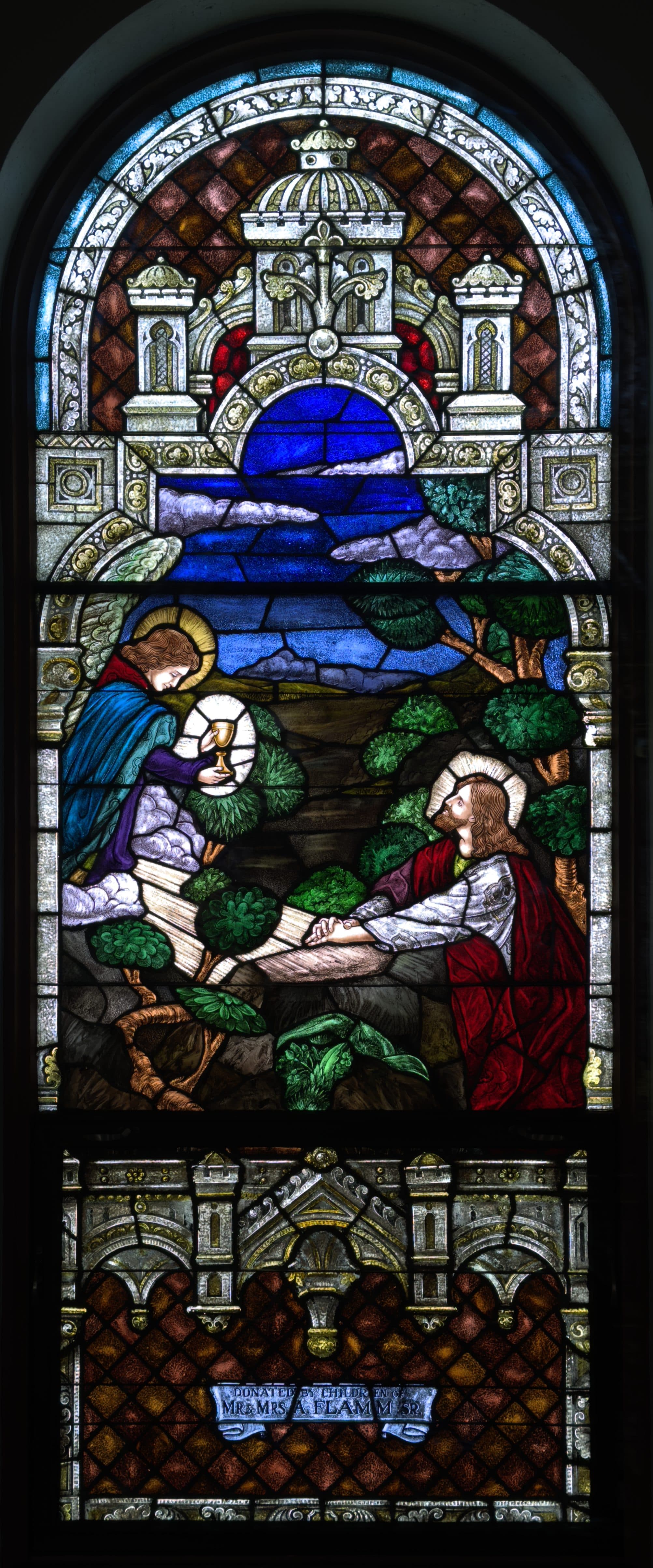
A nighttime garden scene, representing the Mount of Olives just before Jesus' arrest. "Father, if you are willing, take this cup from me; yet not my will, but yours be done." An angel from heaven appeared to him and strengthened him. And being in anguish, he prayed more earnestly, and his sweat was like drops of blood falling to the ground. — Luke 22:42-44 Jesus, kneeling in prayer on a rock in the Garden of Gethsemane, wearing a red robe. His face shows sorrow and anguish. The red robe represents Christ's Passion and sacrificial love, and is the color of Royal dignity: Jesus, the King of the Jews and the King of the Universe. Jesus is also shown with the cruciform halo around his head, signifying his divinity. The Angel, sent by the Father to strengthen Jesus in His human anguish. The angel appears from the upper left, standing on and surrounded by clouds. This is a classic artistic convention showing the angel coming directly from heaven, symbolizing the "Shekinah" or the Glory Cloud of God. The Chalice represents the suffering and death Jesus is about to accept. It is the same "cup" He refers to at the Last Supper when He institutes the Eucharist. The Chalice represents Christ Himself, His Body and Blood that will be offered on the Cross. It is surrounded by a cruciform halo indicating that it is sacred, divine and worthy of adoration because it is the Real Presence of Christ. The Garden setting recalls the Garden of Eden, where humanity fell through disobedience. In this garden, Jesus begins the reversal of that fall through His perfect obedience. Jesus' "Not My will, but yours be done" at the Garden mirrors Mary's "Let it be done to me according to your word". Both are perfect acts of surrender to the Father's will.

Story

The beginning of the Passion. Jesus, in anguish and obedience, accepts the cup of suffering with the prayer "Not my will, but yours be done". This mirrors Mary's Fiat at the Annunciation.

Window 7

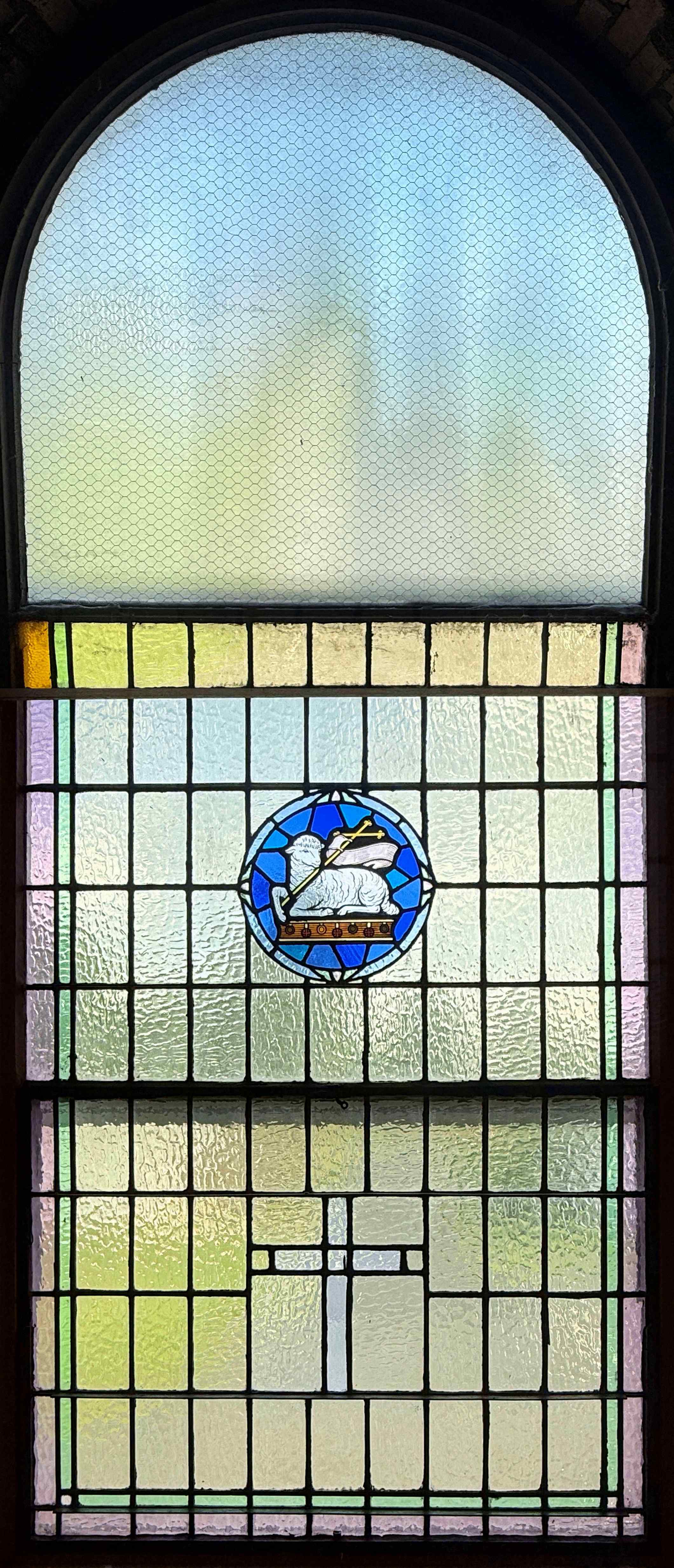
The Paschal Lamb

(Every Eucharist)

Symbology
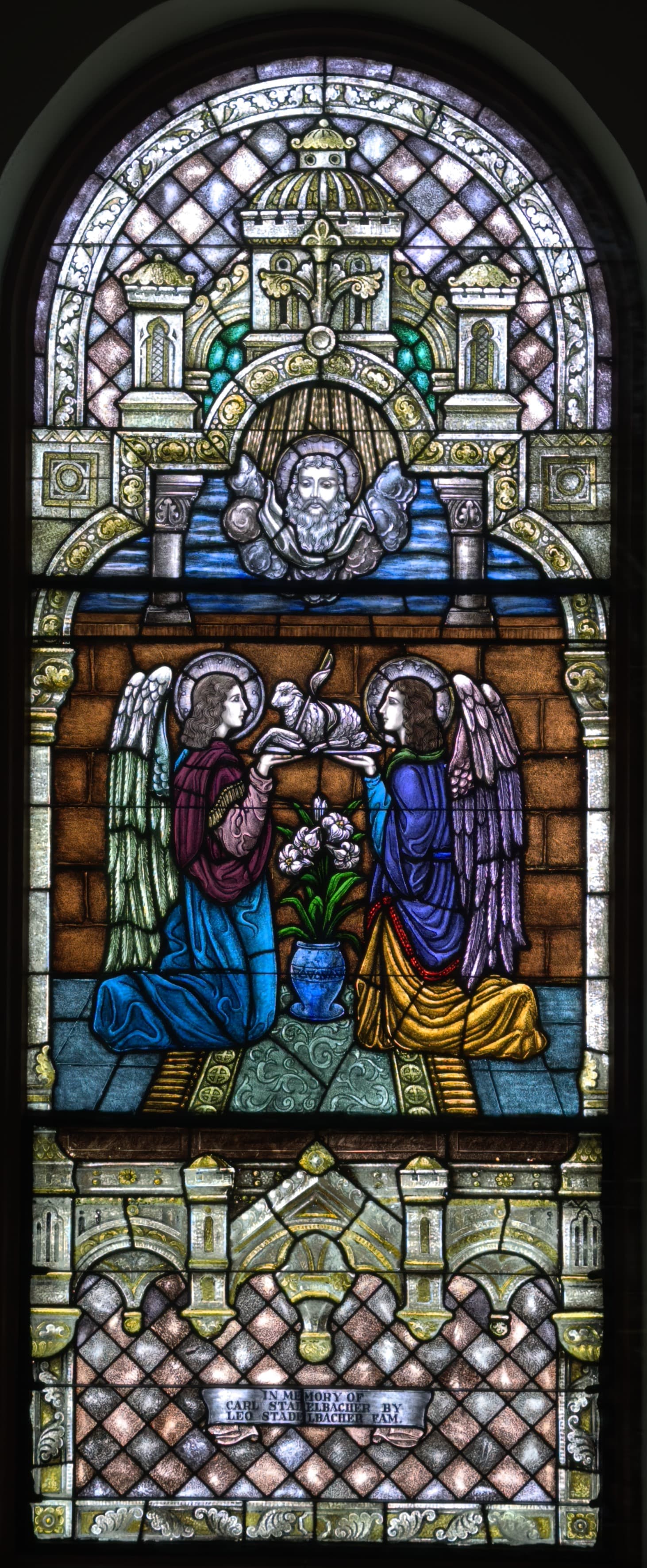
In Catholic theology a "type" (or "typology") is a person or event in the Old Testament that foreshadows a greater reality in the New Testament. In the Old Testament story of the Passover, the Paschal lamb is a spotless male lamb, sacrificed, whose blood protected the Israelites from death and enabled their deliverance from the slavery of Egypt. 1. Yahweh speaks the instructions to Moses. "Each man is to take a lamb… must slaughter them at twilight. Then they are to take some of the blood and put it on the sides and tops of the doorframes of the houses where they eat the lambs. That same night they are to eat the meat." "The blood shall be a sign for you, upon the houses where you are; and when I see the blood, I will pass over you…" — Exodus 12:13 2. Moses speaks the instructions to the people. 3. The people obey, and the miracle happens. (The Angel of Death passes over.) The people then speak the story to their children forever. In the New Testament story, Jesus is the spotless male lamb, sacrificed, whose blood saves humanity from death and enables the deliverance from the slavery of sin. 1. God the Father and Jesus are the instructions. 2. Jesus speaks the instructions to the Apostles. "Take, eat; this is my body." "Drink of it, all of you; for this is my blood of the covenant, which is poured out for many for the forgiveness of sins." "Do this in remembrance of me." 3. The Apostles obey, and the miracle happens. (They are filled with the Holy Spirit of God, and the Church is born.) The Apostles (and their successors, the bishops and priests) institute the Eucharist. The people then speak the story to their children forever.

Story

Jesus is the true Lamb of God, offered to save the whole world. The sacrifice that began at the Last Supper is fulfilled on the Cross.

Window 8

The Sacred Heart of Jesus

(Friday after 2nd Sunday of Pentecost)

Symbology
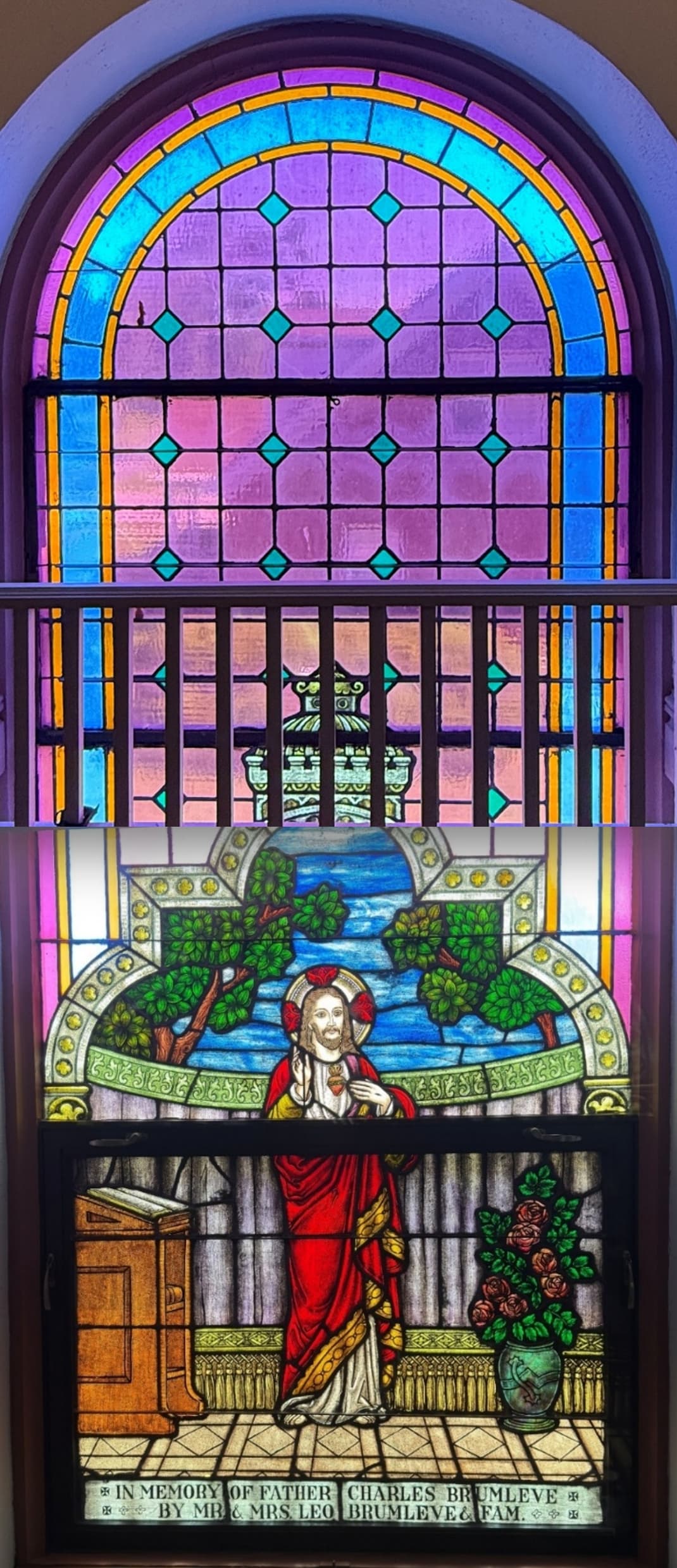
Jesus is wearing a red robe, symbolizing His Passion and kingship. This image is of the resurrected Christ, as evidenced by the piercings on his hands. His right hand is raised in blessing — understood as an extension of the mercy Jesus expressed on the Cross when He said "Father, forgive them, for they know not what they do," while His left hand points to his heart, showing that this merciful blessing is continuous. (Luke 23:34) His Sacred Heart is prominently displayed on His chest, encircled by a crown of thorns — the pain and suffering Jesus endured for our sins. The heart is surmounted by a cross, which is surrounded by flames — the flames represent the infinite, burning love of Christ's Heart. The cross is surrounded by the flames, showing that Christ's love led Him to the Cross. The open book represents the Scriptures, the Word of God, and that the Sacred Heart of Jesus is revealed in the Scriptures. The trees in the background represent the Garden setting, reminding us that Christ's obedience in the Garden of Gethsemane (The Agony in the Garden) reversed the disobedience of Adam in Eden. The Cruciform halo with the floriated elements symbolize the "mystical rose" or the flowering of divine grace through the cross. The imagery comes from the revelations to St. Margaret Mary Alacoque, where Jesus showed her His Heart surrounded by flames and said it was "an inexhaustible source of love and mercy."

Story

The love of Christ for humanity. He sacrifices Himself to provide the blood and bread that will allay the Destroyer and lead all souls to Heaven. His Heart is the source of the Eucharist.

Window 9

St. Thérèse of the Child Jesus

(October 1)

Symbology
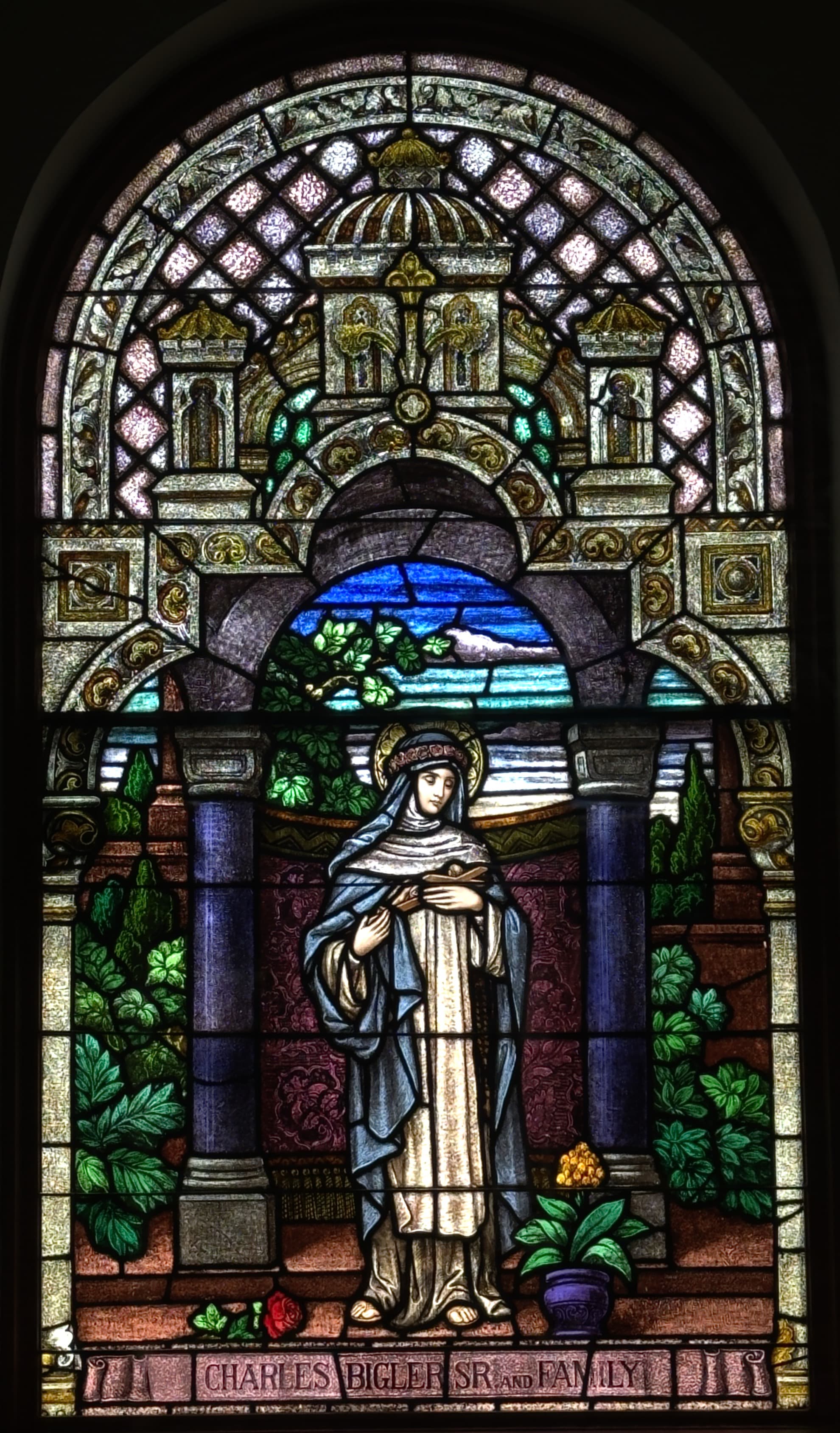
One of the most beloved and influential saints in modern Catholicism. "The greatest Saint of Modern Times" — Pope Pius X The image shows her holding an open book in her left hand (indicating her status as "Doctor of the Church") and a crucifix in her right, signifying her union with Christ's suffering. The crown of roses on her head (indicating her title of "The Little Flower") is a direct reference to her promise to "let fall a shower of roses" from heaven. She stands in a garden-like setting with flowers and architectural columns, evoking the cloister garden of the Carmelite monastery in Lisieux, France. She wrote an autobiography, Story of a Soul, published after her death. It is a spiritual classic, where she describes the spirituality known as the "Little Way" — a path of spiritual childhood, profound trust in God's merciful love, and doing small things with great love rather than seeking heroic deeds. She emphasized the universal call to holiness. Even ordinary people can become great saints through love and trust. "I prefer to remain little, so that I can be carried by God, like a child in its mother's arms. I want to be so little that I will be an atom in the universe, so that I can be lost in God." Her intercession is considered exceptionally powerful. She promised to "spend my heaven doing good on earth."

Story

A modern model of holiness for all of us. Doing everything with great love and childlike trust in God's mercy.

Window 10

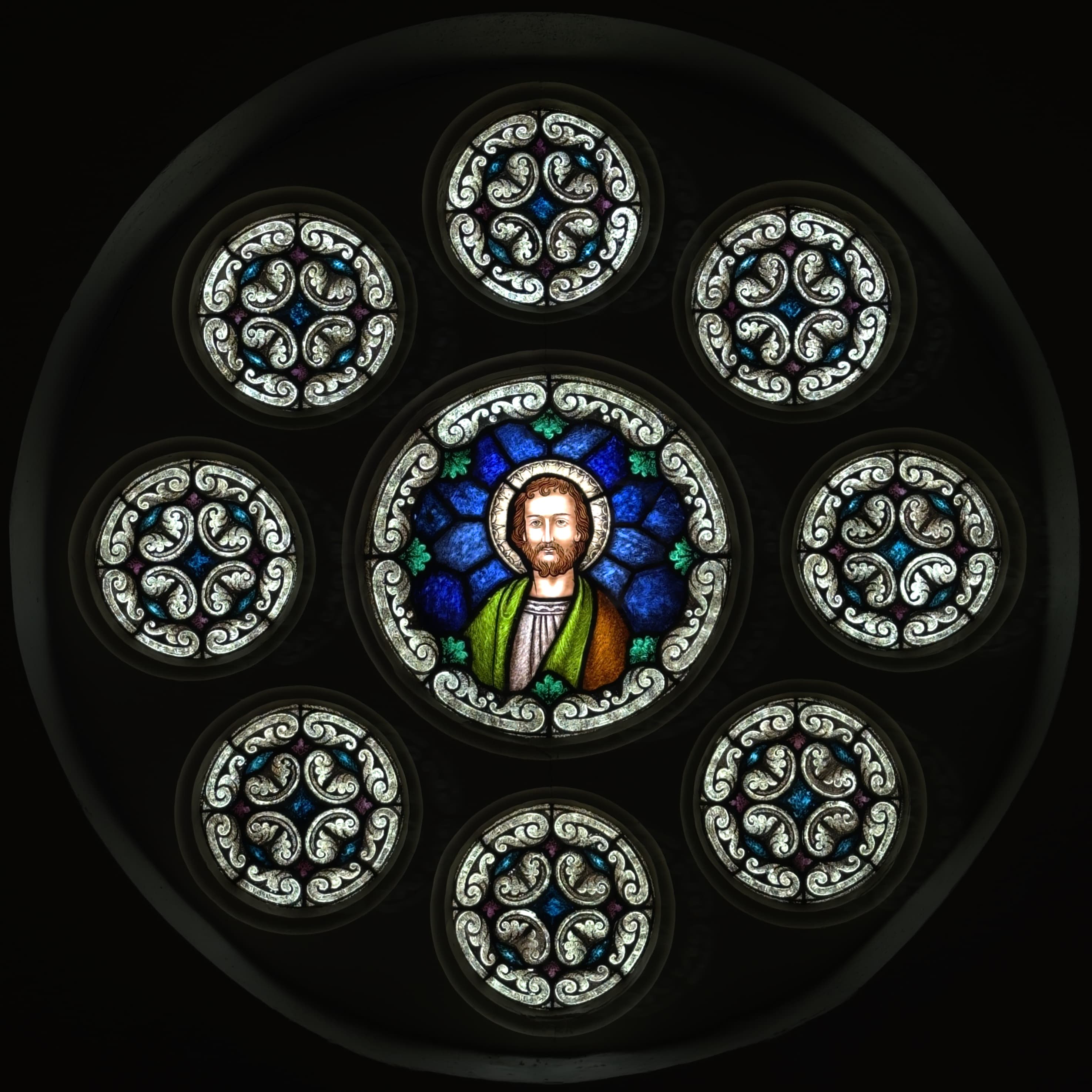
Rose Window with St. Joseph

Symbology

The guardian of the Holy Family watches over the entire story of the New Testament, and is the namesake and patron of St. Joseph's Catholic Church in Cobden.

Story

The guardian of the Holy Family watches over the entire story of the New Testament, and is the namesake and patron of St. Joseph's Catholic Church in Cobden.

← Return to Home